
SUPERCAPACITORSAND AND
HYBRIDS
27/01/2026
Supercapacitors (SC)
Supercapacitors (SC) are systems for storing electrical charge in which energy is stored through the formation of an electric double layer, an electrochemical phenomenon in which ions are arranged near the surface of the electrodes in a configuration similar to that of a capacitor, i.e. a separation of charge without any electron transfer. Using highly porous materials such as carbon nanotubes, graphene and activated carbon (AC), supercapacitors can achieve a specific energy of between 5 and 10 Wh/kg and a specific power of around 10,000 W/kg.
SC are used in energy storage systems that require high power or extremely rapid energy delivery. Conversely, they are less suitable for applications that require high energy storage with slow and prolonged release over time.
Hybrid Supercapacitors (HBSC)
To overcome the limitations of conventional supercapacitors while maintaining high power performance, an effective solution is hybrid supercapacitors, also known as Hybrid Battery Super Capacitors (HBSC). HBSCs are electrochemical storage devices that combine the typical characteristics of supercapacitors and batteries, offering a compromise between high energy density and high specific power.
The operating principle of HBSCs is based on combining components typical of supercapacitors and lithium-ion batteries. This approach can be achieved, for example, by coupling capacitive electrodes with electrodes typical of lithium-ion batteries within the same device.
Consequently, in hybrid supercapacitors, the energy storage mechanism differs between the two electrodes: in one, storage prevails through the formation of the electric double layer, typical of supercapacitors and responsible for the high power output, while in the other, energy is stored through electronic transfer and electrochemical reactions, allowing for an increase in energy density.
HBSC and SC, Technologies Compared:
Depending on the active materials used for the HBSC electrodes, different compromises can be achieved in terms of energy (Wh/kg), C-rate, power density (W/kg) and cycle life.
The table below shows the most common combinations in the design of HBSCs compared to classic SCs:
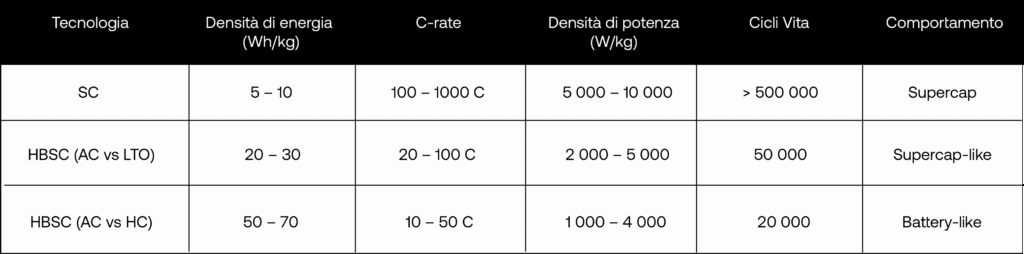
Active carbon (AC) supercapacitors are the supercapacitors par excellence, characterised by extremely high power densities, fast charging/discharging and an extremely long service life, despite their limited energy density.
AC vs LTO and AC vs HC architectures represent intermediate hybrid solutions. In particular, AC vs LTO maintains a discharge profile closer to that of supercapacitors, ensuring high power and long cycle stability, while AC vs HC is in a transitional position, offering a balanced compromise between increased energy density and maintaining good power and cycling performance.
Active carbon (AC) supercapacitors are the supercapacitors par excellence, characterised by extremely high power densities, fast charging/discharging and an extremely long service life, despite their limited energy density.
AC vs LTO and AC vs HC architectures represent intermediate hybrid solutions. In particular, AC vs LTO maintains a discharge profile closer to that of supercapacitors, ensuring high power and long cycle stability, while AC vs HC is in a transitional position, offering a balanced compromise between increased energy density and maintaining good power and cycling performance.
Conclusions
In summary, while traditional SCs excel in applications requiring very high power, fast response and very long cycling, HBSCs represent an intermediate solution capable of bridging the gap with batteries, offering higher energy density while maintaining good power performance and operational reliability.
READ THE OTHER ARTICLES
Supercapacitor technology: a technical overview
SUPERCAPACITOR TECNOLOGY: A TECHNICAL OVERVIEW 15/10/2025 Supercapacitors represent one of the most fascinating developments in the field of energy storage.Unlike traditional batteries, …
Supercapacitors: the key to modern logistics
SUPERCAPACITORS: THE KEY TO MODERN LOGISTICS 25/09/2025 From automated warehouses to AGVs: how supercapacitors are transforming logistics processes The evolution of logistics, …